30 November 2025
 Share
Share
1


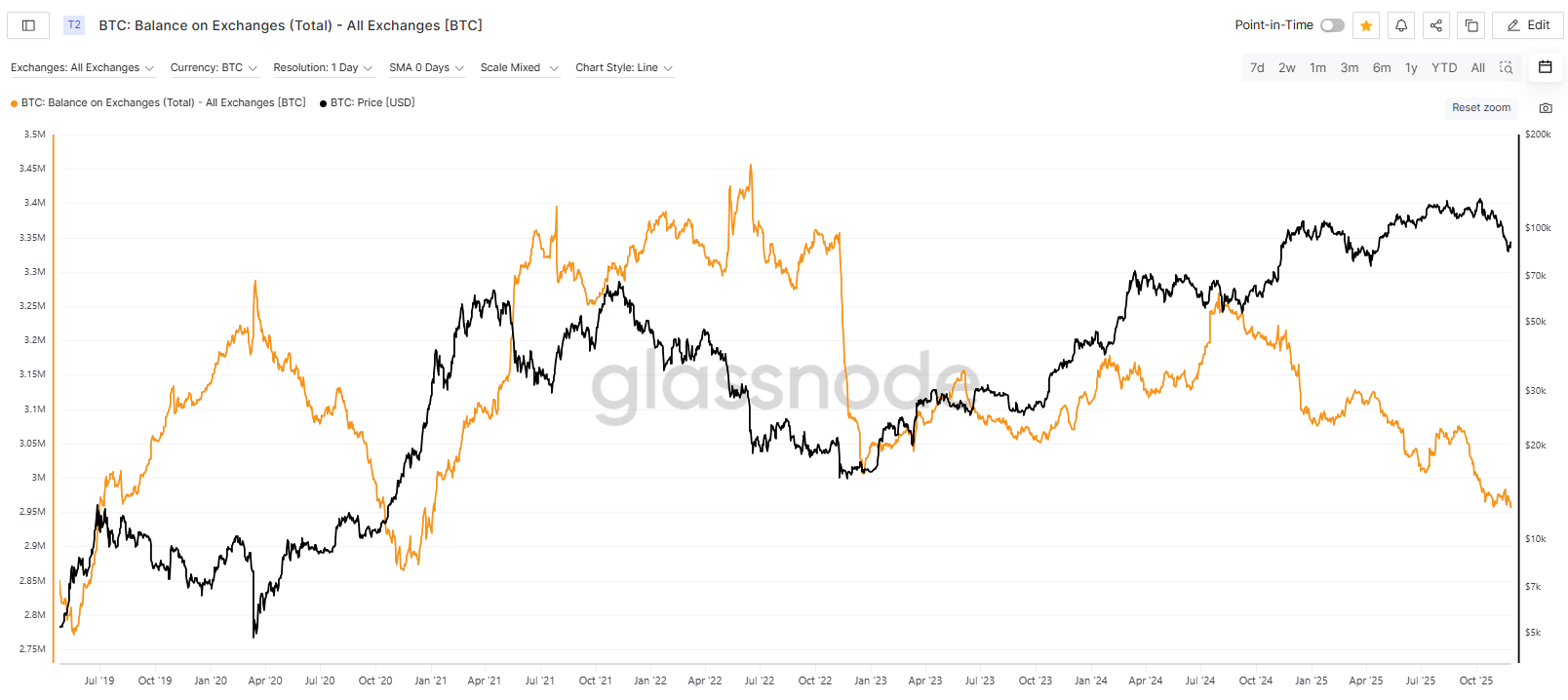
Bitcoin has not yet experienced a serious liquidity crisis, but its future suggests that the problem is only a matter of time. According to Glassnode, the current outflow of coins from exchanges is one of the main factors that will gradually limit BTC tradability.
Less than 3 million BTC are currently on exchanges, the lowest number since January 2021. This trend accelerated after the FTX collapse at the end of 2022, when 300,000 BTC disappeared from exchanges in a single month. Trust in Bitcoin is growing and investors are increasingly unwilling to keep their coins on exchanges because they are not ready to sell them.
Currently, almost 20 million coins exist out of a total of 21 million, but the actual liquid supply is much lower. It is estimated that 4 to 6 million BTC may be irretrievably lost, dramatically limiting the possibility of instant trading. In addition to outflows from exchanges, lost coins are another factor. These are coins permanently inaccessible due to lost private keys or long-term holding.
Buy Bitcoin on Binance and get a $100 bonus
For smaller exchanges with limited trading volumes, a liquidity crisis can cause significant problems. Sudden price changes or unexpected purchases may be difficult to manage. Long-term trends indicate that the gradual outflow from exchanges, combined with growing investor trust and an increasing number of lost coins, will lead to a situation where BTC liquidity will be limited.
Investors should consider that even if a liquidity crisis occurs in a few years, its impact will be noticeable. Trading on smaller platforms may be challenging, and price volatility may increase. A solution may be diversification across exchanges with higher volumes and holding BTC in secure wallets off exchanges.
The overall scenario shows that a liquidity crisis is a natural part of Bitcoin’s growing ecosystem. Bitcoin. Outflows from exchanges, irretrievably lost coins, and growing holder confidence indicate that available liquidity will gradually decline. This trend is important to monitor when forming investment strategies and managing risk, as liquidity will become a key factor affecting price and market stability.