06 July 2025
 Share
Share
1


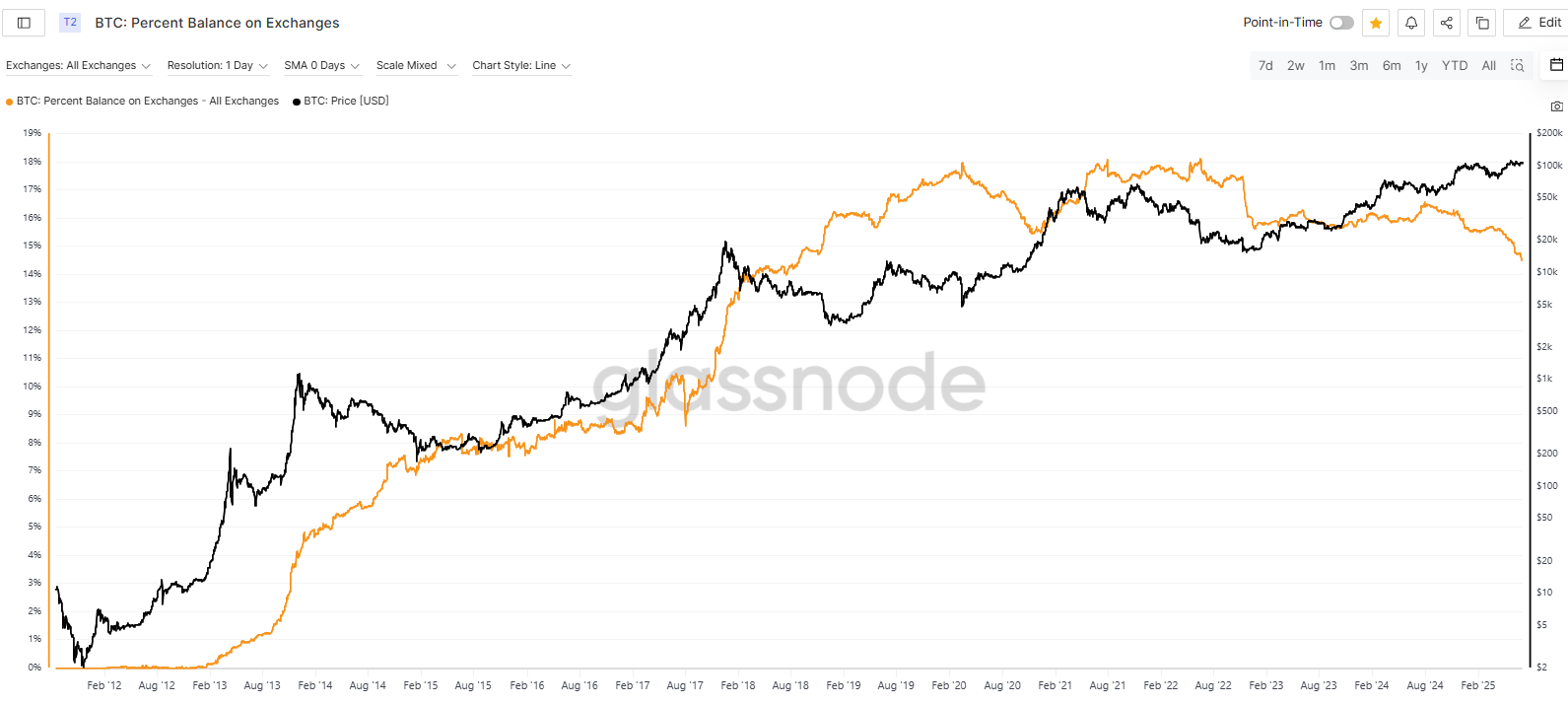
Bitcoin is experiencing a period of key market shifts. According to AMBCrypto, there was a significant drop in its exchange balances in June, from 3.09 million to 2.8 million BTC. This 9.4 % decrease represents the lowest share of exchange-held Bitcoin since 2017 – only 14 % of the total circulating supply.
Historically, such structural declines in liquid supply are often precursors to imbalances between supply and demand. When demand exceeds available liquidity while investors diversify, the result can be a sharp increase in price.
Furthermore, according to Glassnode data, as much as 86 % of Bitcoin is currently held off exchanges, suggesting that the market may be preparing for a classic “supply squeeze” – a condition where limited supply meets rising demand.
Buyers on the market confirmed this by triggering a $40 million liquidation wave, which temporarily pushed the price back above $107,000. However, this move is not random – it underlines the changing dynamics of the market.
While it may seem that the market is moving upward, it’s not just about the numbers. A key indicator is where the liquidity is going. According to data from CryptoQuant, the volume ratios between spot and derivative markets have increased – from the May low of 0.05 to a monthly high. This indicates that the market is beginning to rely more on actual purchases rather than speculative bets.
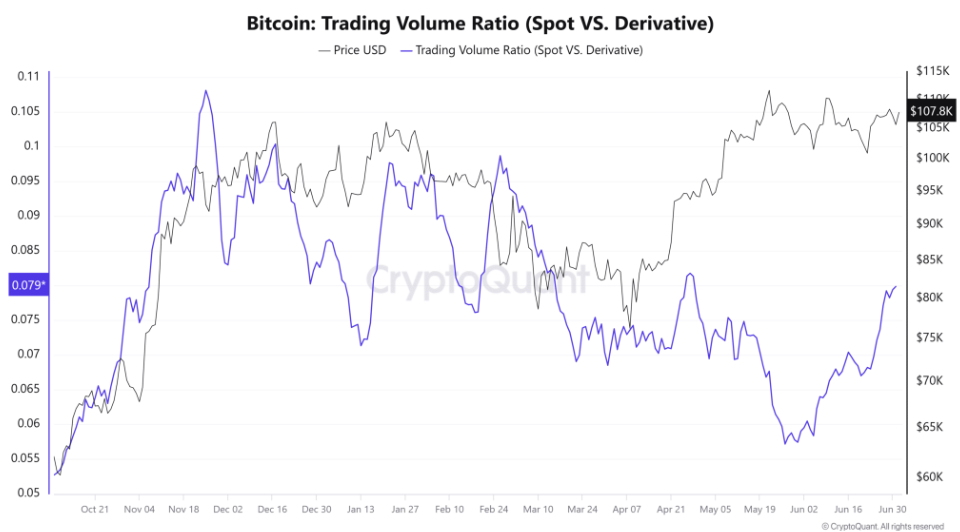
In the past, when this ratio was low, Bitcoin reached its all-time high – but with minimal involvement from the spot market. This led to exaggerated movements and subsequent corrections.
After breaking through the $111,000 level, a wave of liquidations followed, quickly dragging the price below $100,000. However, a new trend is emerging – rising spot volume combined with a record low exchange supply may signal a transition into a growth phase driven by real demand. If this trend persists, Bitcoin could experience a price surge fueled not by speculation but by a lack of supply.