22 November 2025
 Share
Share
1


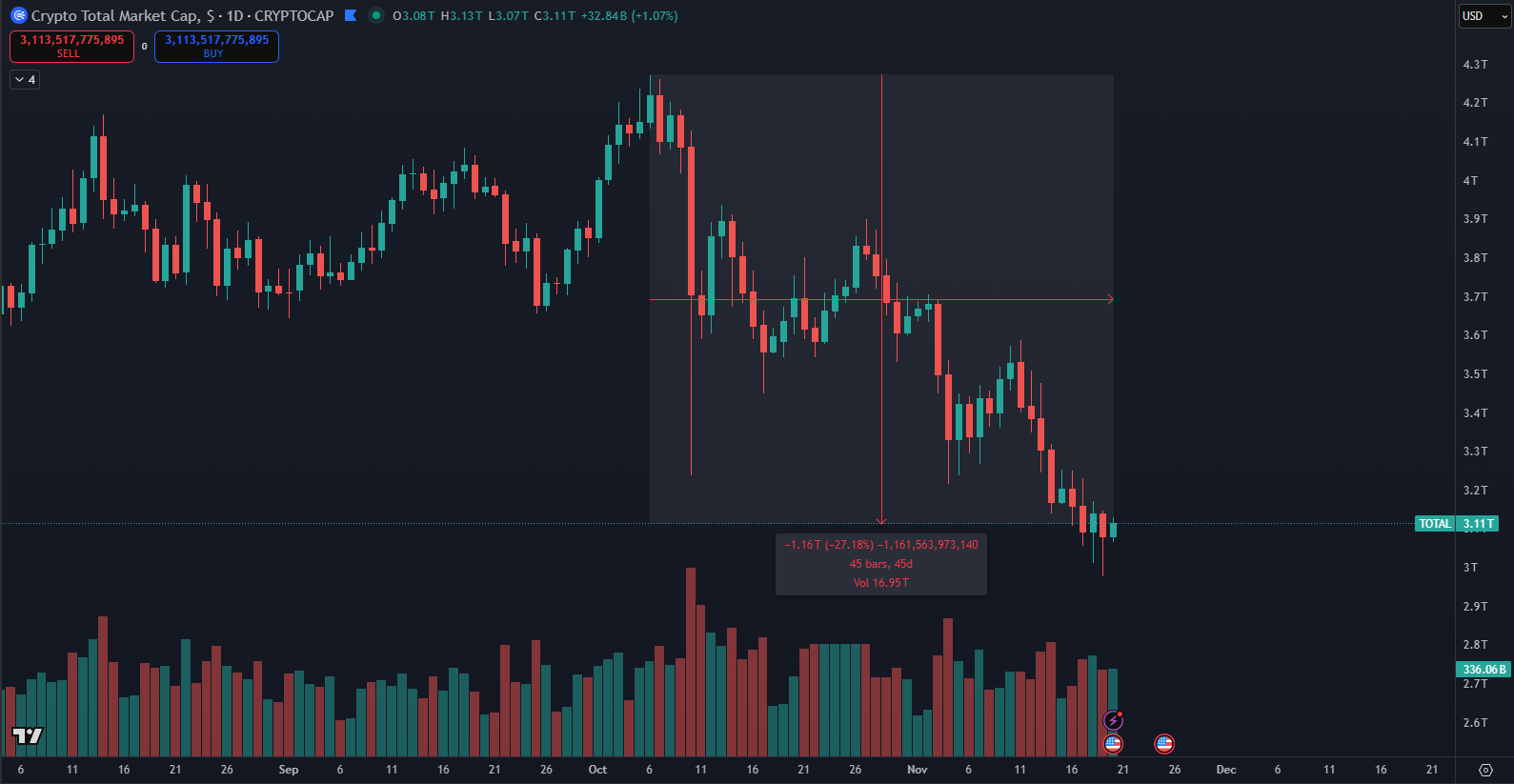
Cryptocurrencies have entered a period where the momentum of recent months has left many investors puzzled. According to TradingView, the total cryptocurrency market capitalization reached its peak on October 6, 2025, at 4.27 trillion dollars. It was a period dominated by optimism, with the market riding a wave of massive capital inflows.
However, the situation quickly reversed. Over the next 45 days, approximately 1.16 trillion dollars disappeared from the crypto market, representing a correction of over 27%. This is one of the most significant drops in the modern history of digital assets, reigniting debate about what it actually means when “money evaporates” and where it precisely goes.
Market capitalization is not the amount of cash people invested in cryptocurrencies, but the current market value of all tokens based on the last price someone was willing to trade. When the value falls, it does not mean billions physically disappeared. Rather, it reflects that most investors no longer want to buy at the previously high prices, so the last trade price sets a lower value for the total circulating token volume.
You can turn the decline in crypto prices to your advantage by taking advantage of cheaper purchases on the Binance platform. This allows you to expand your portfolio more efficiently and flexibly than during the market peak.
Buy crypto for lower prices on Binance and get 100 $ bonus
When the market drops, capital generally moves. Investors convert their positions back to fiat, move funds to more stable assets, or simply stop buying, which weakens demand. When demand disappears, the price naturally slides down, reducing market capitalization.
It is important to understand that money does not evaporate. If an investor sells a token at a low price, the difference between its previous value and the sale price is unrealized potential. In other words, the value existed only on paper, not as real funds. When a large group of people starts selling simultaneously, the number of buyers is simply insufficient, and the price drops even more sharply.
At the same time, every drop is only the result of the last trade. If one Bitcoin is sold at a lower price, the value of all Bitcoins on the market automatically decreases, even if most owners did not sell.
For the market, this means that the period after a correction is a time for reassessment. Investors examine whether it is a healthy cleansing after extreme growth or a precursor to deeper cooling. In both cases, a declining capitalization reflects not a flight of real money, but a change in sentiment and willingness to buy.